
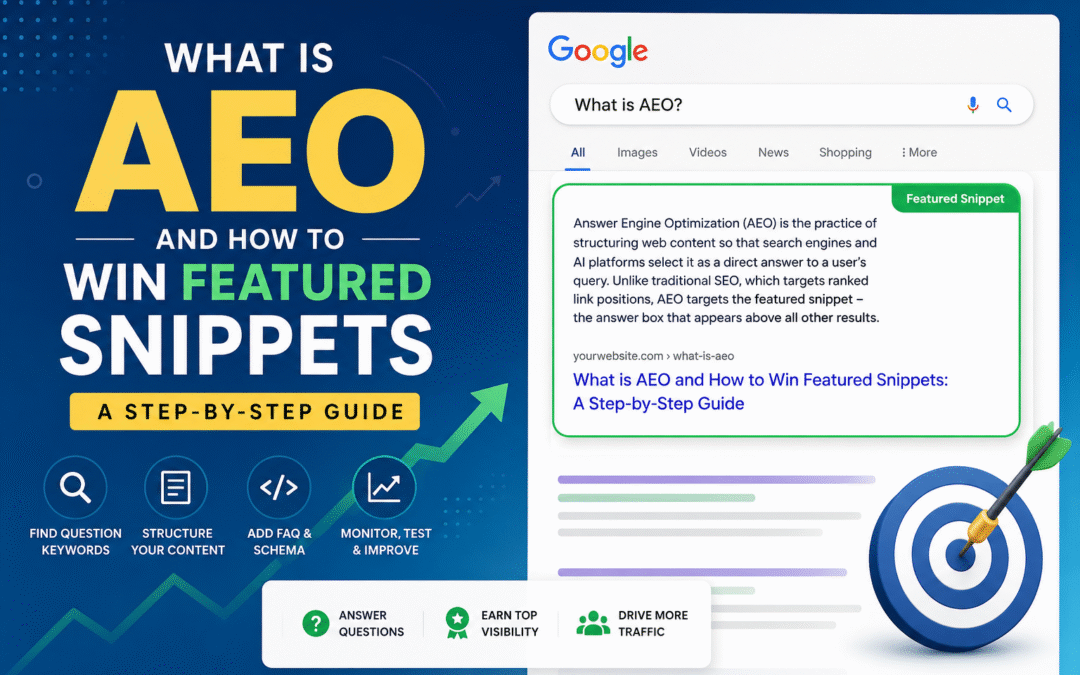
Whenever you type a question in Google, you will find a box with a direct answer at the very top of the page. This appears before the list of results. This is known as a featured snippet or position zero, and it is the primary target of Answer Engine Optimisation (AEO).
Since AI overviews, voice assistants, and ChatGPT generate answers rather than links, AEO has become immensely important in the SEO strategy toolkit.
To know what AEO is and how to win featured snippets, read on.
What is Answer Engine Optimisation (AEO)?
Answer Engine Optimisation is the practice of structuring content so that search engines and AI platforms select it as a direct answer to a user’s query. While traditional SEO gets your web page into the top 10 results, AEO’s job is to make your page the answer that appears to users.
“Featured snippets appear in approximately 12% of all Google searches. For question-based queries, that figure is considerably higher — making AEO especially powerful for informational and service-related content.”

AEO content helps AI Overviews, Perplexity, and ChatGPT fetch content from webpages and create direct answers.
Also Read: AEO vs SEO – What are the Differences between Both and How to Succeed with Both Strategies?
How to Win Featured Snippets: 8 Practical Steps
Step 1: Find Question-Based Keywords Your Audience Is Already Searching
Featured snippets always appear with a direct answer to question-based queries posted on Google. Hence, when structuring the content, you need to identify the questions the audience is asking about the products and services.
You can check:
- Google’s ‘People Also Ask’ sections and get an idea.
- Google’s autocomplete suggestions
- Question-based tools like AnswerThePublic.com
- SEMrush or Ahrefs ‘Questions’ filter
Step 2: Understand the Four Types of Featured Snippets
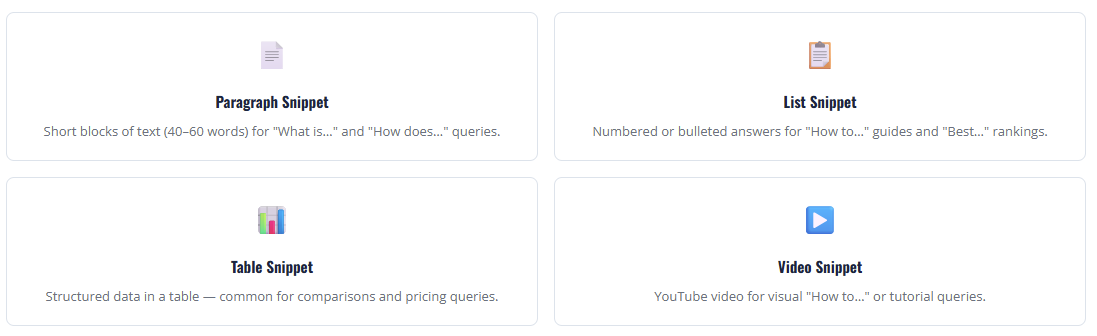
There are 4 types of snippets, and knowing them will help you structure the content accordingly.
Paragraph snippets are short blocks of text (40–60 words) that directly answer a question. The queries generally start with ‘What is…’ and ‘How does…’.
List snippets – answers are presented in a numbered or bullet list. Common queries start with ‘How to…’ guides and ‘Best…’ rankings
Table snippets – answers are presented in structured data displayed in a table. Commonly generated for queries related to comparisons or pricing.
Video snippets – answers presented with a YouTube video for the common queries like ‘How to…’ or guiding videos.
It is essential to match the content’s structure to the snippet to gain visibility for the target query.
Step 3: Structure Your Content Around a Direct Answer First
This is the most important principle for a successful AEO. Most of the time, the direct answer appears between the content and the introduction. However, for AEO, a clear, concise answer is required at the outset. For this use:
- Restate the question as a heading (H2 or H3)
- Provide a direct, 40–60-word answer immediately below the heading
- Follow with a deeper explanation, list, or table for users who want more detail
Example structure for the query ‘What is AEO in SEO?’:
H2: What Is AEO in SEO? Answer Engine Optimisation (AEO) is the practice of structuring web content so that search engines and AI platforms select it as a direct answer to a user’s query. Unlike traditional SEO, which targets ranked link positions, AEO targets the featured snippet — the answer box that appears above all other results. [Expanded explanation follows…]
Step 4: Use the Right Heading Structure
Google uses the heading hierarchy to understand the question and create an answer. Hence, it is essential to maintain a clean and organised H1 > H2 > H3 structure in the content.
- Use the target question as H2 or H3
- Avoid multiple heading layers, as it confuses the search engine
- Use H3 subheadings and break down the longer content into small sections
- Maintaining hierarchy in headings without skipping the levels
Step 5: Add FAQ Sections to Every Key Page
FAQ questions are the best option to route the page to featured snippets. It is thus essential to have a well-structured FAQ page and a separate FAQ section for each blog post. Best practices that you can follow are:
- Use actual questions
- Keep each answer between 40 and 60 words
- Use H3 headings for each question
- Add FAQ schema markup
Step 6: Implement FAQ Schema Markup
Schema markup is structured data code added to your pages that tells search engines exactly what type of content they’re reading. For WordPress websites using Yoast SEO, the schema is added without altering the code. For custom-built websites, the developer will add JSON-LD schema directly to the page.
Step 7: Optimise for Voice Search
Voice search queries are generally longer, more conversational, and phrased as complete questions. When you ask a phone or smart speaker a question, the device reads out the featured snippet. Hence, it is required to optimise the voice search. You need to:
- Use long-tail, conversational question phrases
- Write answers in plain, natural language and in layman’s terms
- Use clear and simple sentences and aim for a reading age of around 10–12 years
- Include your location in answers wherever they are relevant
Step 8: Monitor, Test and Iterate
Featured snippets can be won and lost as Google continuously re-evaluates content and selects the one that best fits the query. During performance monitoring, it is essential to:
- Use Google Search Console to track queries that appear on the site
- Use SEMrush or Ahrefs to track featured snippet positions
- Analyse the competitor’s formal answer
- Update existing content regularly
For more information on AEO and featured snippets, get in touch with Object Ad Solutions. We provide a range of services, including web design, development, SEO, Ads, and advertising consultation.
Frequently Asked Questions
How long does it take to win a featured snippet?
For lower competition questions, you can win a snippet within days. For highly competitive queries, it may take several weeks or months.
Do I need to rank on page one to win a featured snippet?
Google selects featured snippets from pages that already appear in the top 10 results. If the rank is not visible on page one, first focus on traditional SEO, then apply AEO formatting.
Recent Comments