
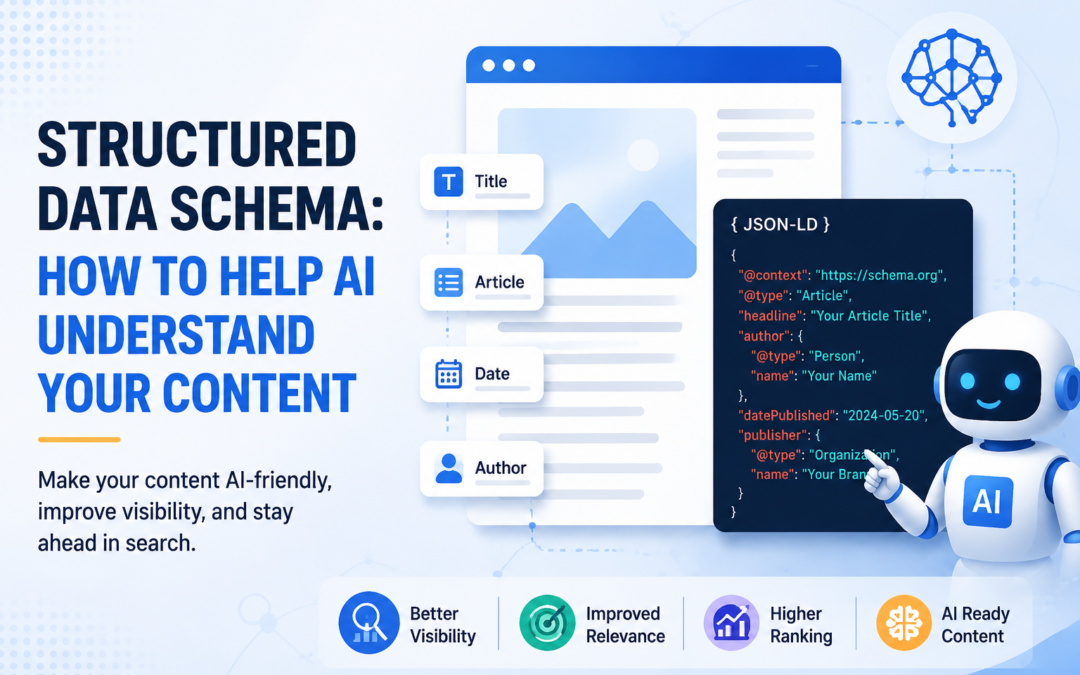
Search engines and AI platforms are extraordinarily capable — but they can’t read your website the way a human does. They need context. They need to know whether a block of text is a product description, a customer review, a step-by-step guide, or a business address. Here, a reputable SEO company in Brighton plays an important role. They provide context through structured data, and in 2026 it has never been more important to get it right.
This guide explains what structured data and schema markup are, why they matter for both traditional SEO and AI search platforms, and which schema types your website should implement right now.
What is Structured Data and Schema Markup?
Structured data is a standardised format. It provides information about a page and its content to search engines. Schema markup is the vocabulary the specific set of tags and properties used to write that structured data.
Think of it this way: your web page might contain your business address, opening hours, customer reviews, and a list of services. Without schema markup, a search engine has to guess what each piece of information means. With schema markup, you’re telling it directly in a language it reads fluently.
The vocabulary for schema markup is maintained by schema.org, a collaborative project by Google, Microsoft, Yahoo, and Yandex. The most common way to implement schema on modern websites is through a format called JSON-LD — a small block of structured code added to the head or body of your page.
Schema markup doesn’t just help Google rank your content it helps AI platforms like ChatGPT, Perplexity, and Google’s AI Overviews understand what your content is about, making it far more likely to be cited as a trusted source.
Why Structured Data Matters More in the Age of AI
Structured data has been an SEO best practice for years. But the rise of AI-powered search has made it significantly more valuable, for two reasons.
1. AI Platforms Need Clear Signals
Large language models and AI search engines don’t browse the web the way a traditional crawler does. They process vast amounts of content and look for clarity, consistency, and context. Structured data provides exactly that — a machine-readable layer of meaning that sits alongside your human-readable content.
According to an SEO company in Brighton, a page with well-implemented schema is far easier for an AI system to understand, categorise, and confidently cite than an unstructured page — even if the written content is identical.
2. Rich Results Drive Higher Click-Through Rates
Traditionally, the schema markup provided high yields. It enhanced SERP features including star ratings and FAQ dropdowns. The schema markup also provided the best results: for recipe cards, event listings, and product prices displayed directly in Google’s results. These rich visual listings helped get a standard blue link.
Stat to know: Pages with FAQ rich results have been shown to achieve significantly higher SERP visibility and click-through rates than equivalent pages without them even when ranking in the same position.
The Most Important Schema Types for Your Website in 2026
There are hundreds of schema types on schema.org. However, do all brands need everything? Well, no, most websites only need a handful. Here are the ones that deliver the greatest SEO and AEO value:
❓ FAQ Page Use for: Pages with a Q&A or FAQ section. Rich result: FAQ rich results — expandable Q&As shown directly in the SERP
📋 How-to Use for: Step-by-step instructional content Rich result: Step-by-step rich results with numbered stages shown in search
📰 Article / Blog Posting Use for: Blog posts and editorial content Rich result: Article rich results; improves content categorisation for AI
🏢 Local Business Use for: Local service or brick-and-mortar businesses Rich result: Business info panel; feeds Google Maps and voice search results
⭐ Review / Aggregate Rating Use for: Products, services, or businesses with ratings Rich result: Star ratings displayed in search results
🛍️ Product Use for: E-commerce product pages. Rich result: Price, availability, and ratings shown in search
🎤 Speakable Use for: Content optimised for voice assistants. Rich result: Signals which sections of a page are suitable for text-to-speech
For most small business websites, the priority order is:
Local Business → FAQ Page → Article/Blog Posting → How-to.
Implement these four, and you will have covered the vast majority of your schema needs.
How to Implement Schema Markup on Your Website
The most widely recommended format for schema markup is JSON-LD (JavaScript Object Notation for Linked Data). It lives in a script tag on your page and does not require changes to your visible HTML — making it clean, manageable, and easy to test.
On WordPress
If your site runs on WordPress, schema implementation is straightforward. You don’t even need to touch code.
- Yoast SEO — automatically adds Article and Local Business schema; has a dedicated FAQ block that outputs FAQ Page schema
- Rank Math — highly configurable schema support across most schema types; recommended for more advanced implementations
- Schema Pro — a dedicated plugin for granular schema control across all page types
Schema, E-E-A-T, and AI Trustworthiness
Structured data is one of several signals Google uses to evaluate a page’s E-E-A-T (Experience, Expertise, Authoritativeness, Trustworthiness). For AI platforms evaluating which sources to cite, these trust signals are critical.
Beyond schema type, these additional structured data elements strengthen your E-E-A-T profile:
- Author schema — identifies the author of a piece of content, their credentials, and their profile page
- Organisation schema — establishes your business identity, logo, and contact details at a site-wide level
- Breadcrumb List schema — communicates your site’s content hierarchy to search engines
- Site links Search Box schema — enables a search box for your site to appear directly in Google’s brand results
AI platforms cite sources they trust. Schema markup is one of the clearest ways to communicate trustworthiness in a language AI can read. An unstructured page and a well-schema’s page with identical content are not equal in AI search — the structured page wins.
Recent Comments