
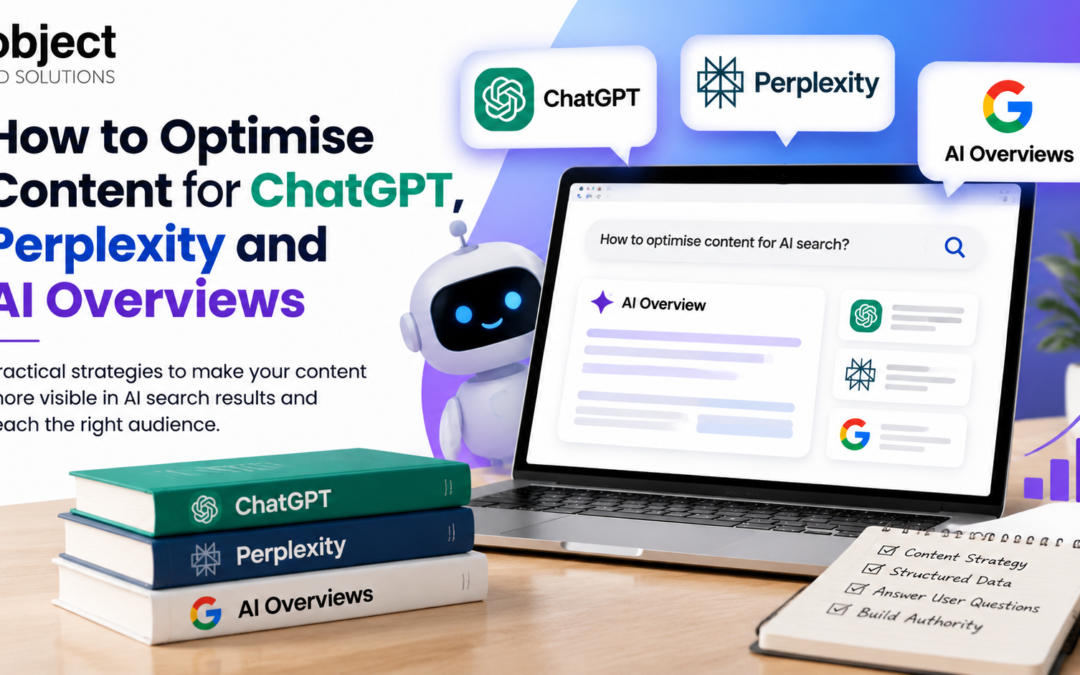
The search process is changing. Users are asking complete questions rather than searching with simple keywords across all search engines. Platforms such as ChatGPT and Perplexity provide conventional answers, while Google’s AI Overviews will give you summarised information directly through the search engine.
What does this mean? This means your content should be useful. It should not only benefit SEO but also be framed for AI-driven search experiences.
Content that directly answers users’ questions
AI platforms evaluate the meaning and context behind a query. Perplexity, for instance, combines information from multiple sources and presents a conversational answer with proper citations.
1. Use question-based headings
Audiences are asking direct questions. Hence, if you frame your content around questions that the audience asks, instead of a statement-like heading such as “Commercial Cleaning Services”, then you can make your content visible on the AI search platforms.
For instance, if you offer cleaning services, then frame your content headings likewise:
- What does commercial cleaning include?
- How often should you hire professionals for cleaning services?
- How to reduce cleaning-related disruption?
- What are the costs of commercial cleaning?
2. Highlight important information for easy extraction
Do not make long paragraphs. Use short sections, bullet points, informative tables, and step-by-step definitions.
Clear formatting gives the audience distinct, easy-to-understand pieces of information.
3. Give original information
Long paragraphs with no factual information won’t help. To appear in ChatGPT, Perplexity, and AI Overviews, include original, relevant statistics, comparisons, and examples.
For manufacturing businesses, clear processes and design details, along with competitor comparisons, can help your content rank on AI platforms. However, always support factual claims with a credible source.
For instance, in content about commercial solar panels, include installation considerations, maintenance requirements, and performance factors to build credibility.
4. Give current information
If your business website has pages on prices, industry developments, competitor analysis, or regulations, update them regularly with dates to keep the information current and help the website rank in AI tools.
5. Optimise technical accessibility
Content becomes good when it’s accessible to search crawlers. OpenAI advises content publishers who want their websites to appear in AI tools like ChatGPT to produce relevant content and optimise technical accessibility so crawlers can access it effectively. Perplexity, on the other hand, follows PerplexityBot’s crawling instructions and respects robots.txt when crawling different websites.
6. Appropriate page structure and schema
To optimise content, use clear, descriptive title tags with logical H1, H2, and H3 headings within the content. Also, make URLs readable and use appropriate structured data. This makes it easier for Google to understand the structured data and the page content. Schema should also accurately represent all visible content, not content added to influence search appearance and results.
7. Write for people first
AI optimisation doesn’t mean you’ll have to produce content with lots of keywords or write in a robotic tone. Instead, frame your content to answer the audience’s real-time questions. Offer them something more than generic summaries. ChatGPT Search, Perplexity, and Google AI Overviews always value informative, well-structured content.
Contact Object Ad Solutions for content optimisation that reaches the right customer segment and drives real results. Our approach is completely transparent, giving you clear ROI reporting at every step.
Frequently Asked Questions
Do AI Overviews appear for all local search queries?
Not yet for all queries, but their prevalence is growing rapidly. They are particularly common for informational queries (‘how to find a good accountant in Brighton’), comparison queries (‘best plumbers in Surrey’), and service explanation queries (‘what does a conveyancer do’). Pure transactional queries with strong map pack results are less likely to trigger an AI Overview, but this is evolving.
Can a small local business realistically appear in Google AI Overviews?
Yes, and in many cases, small local businesses with strong GBP profiles, genuine reviews, and well-structured website content outperform larger competitors in AI Overviews. AI systems prioritise clarity, trust, and local relevance over domain size. A well-optimised independent business can absolutely be cited ahead of a national chain.
How do I know if my business is appearing in AI Overviews?
Search for your key service and location queries on Google using an incognito browser window (to remove personalisation). Note whether an AI Overview appears and, if so, whether your business is cited. You can also use tools like SE Ranking or Bright Local, which are developing AI Overview tracking features. Google Search Console does not currently report AI Overview appearances separately from organic results.
Will optimising for AI Overviews hurt my traditional organic rankings?
No, the steps required to optimise for AI Overviews (clear content, structured data, strong GBP, consistent NAP, genuine reviews) are all established best practices for traditional local SEO as well. Optimising for AI Overviews reinforces rather than conflicts with your standard local SEO strategy.
How long will it take to see results from these steps?
Some steps like completing your GBP and fixing NAP inconsistencies — can have an effect within a few weeks once Google re-crawls your information. Content-based improvements typically take 1 to 3 months to be reflected in AI Overview appearances. Google usually processes schema markup changes within days to weeks. Think of this as a three- to six-month programme rather than an overnight fix.
Recent Comments